

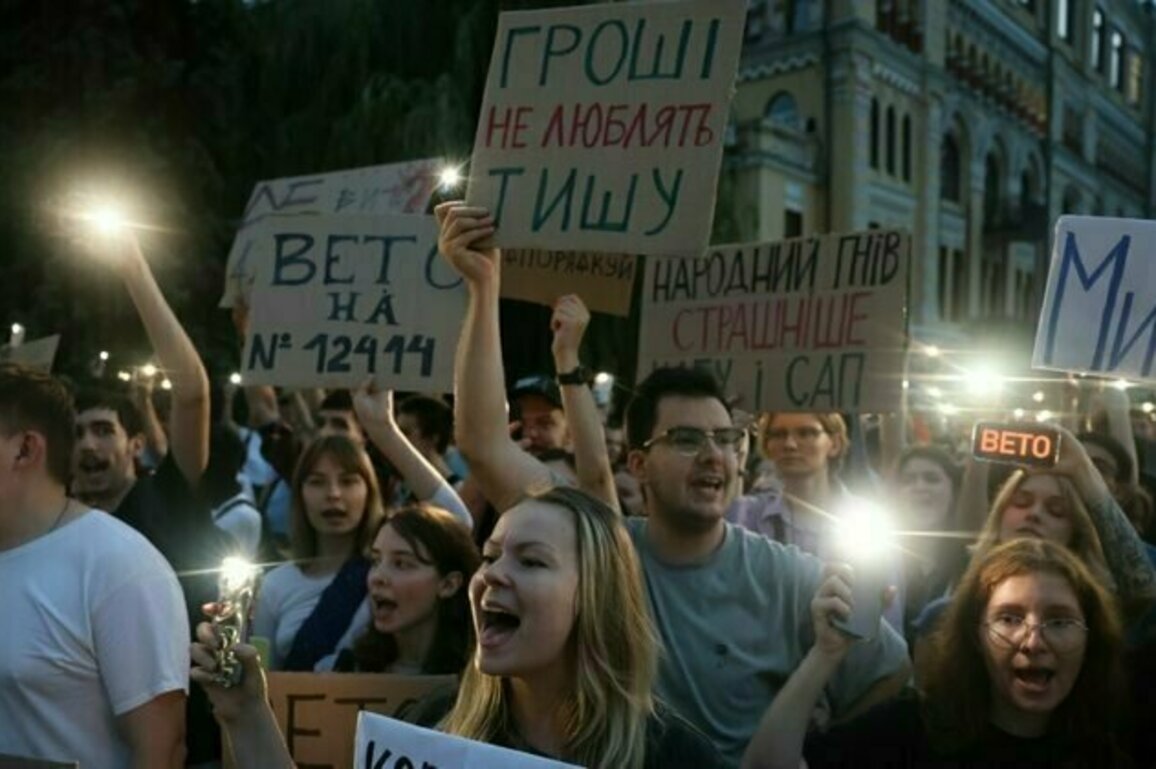
A poster held by a protester in Kyiv captured the anger and disbelief many Ukrainians are feeling after parliament passed a bill - swiftly signed by President Volodymyr Zelenskyy - that critics say willcurb the independenceof two key anti-corruption agencies and badly set back the countrys hard-won progress toward democracy and the rule of law.
"This is not the future my brother died for, it read.
A protester in Kyiv on July 22 holds a sign that reads, "This is not the future my brother died for."
In just a few words, that message touched on at least a dozen years of Ukraines tumultuous recent history, from the Maidan protests that pushed Moscow-friendly President Viktor Yanukovych from power in 2014 to Russias war against Ukraine, which rages on 41 months after the start of the full-scale invasion in February 2022.
As the country struggles to fend off the Russian invasion, which has killed tens of thousands of Ukrainian soldiers and civilians and uprooted millions of citizens, passage of the law restricting the autonomy of the anti-corruption agencies has, for many, raised a stark and simple question: What are we fighting for?
We had two relatively independent institutions that at least created the appearance -- or even the reality -- of checks and balances. If we dismantle them, well slide into a fully controlled state, said Anton, a protester in the southeastern city of Dnipro, not far from the front. I wouldnt want to live in a country like that.
A Major Setback?
The monthslong Maidan protests, which came to be known as the Revolution of Dignity, began as demonstrations of anger over government corruption, which has plagued Ukraine since independence in 1991 and was seen as getting worse.
They swelled to massive proportions after Yanukovych abruptly abandoned plans to sign a trade agreement with the European Union and tightened ties with Russia instead.
SEE ALSO:
The Maidan Generation: Activists Reflect On A Turbulent Decade In Ukraine
The Maidan protests and the defense against the Russian onslaught are just the most prominent examples of efforts by Ukrainians to safeguard independence - due to Moscows aggression, still in peril almost 35 years after the Soviet collapse - and to put as much distance as possible between Ukraine and both its Soviet legacy and the backward-looking, deeply unfree country Russia has become.
Defenders of the institutions affected by the new law - the National Anti-Corruption Bureau of Ukraine (NABU) and the Specialized Anti-Corruption Prosecutor's Office (SAPO) - say that a working system of independent anti-corruption bodies has been a crucial step in that direction for Ukraine, and that the legislation is a major setback.